

Adobe, Claude and the end of Software
Software is becoming a dead end for businesses.

- The end of dashboards
- The problem
- 60% of SaaS will die?
- Moats and Goats
- Ingestion
- Oligopoly
- Your cute vibe coded app
- But, but, but…
- Dario was wrong
- Ways out
AI BUBBLE WEEKLY 8
Someone just vibe coded the entire Adobe Suite. Photoshop, Lightroom, even an After Effects replacement. And they made the apps free (or $70 one-time payment, that's unclear).
For millions of people that only use Photoshop sporadically and for basic stuff, that's life-changing. Adobe Stock reacted immediately.

On the other hand, Claude just introduced Dashboards. A custom UI that generates for you on the fly from various data sources.
Both of these things are closely connected.
What ties them together is how they announce the end of software as we know it. And no, we're not clickbaity-dramatic here. Not ALL software will end. There will be apps. Just less apps. Less revenue.
Maybe it's better to learn how to do flooring or plumbing.

The end of dashboards
Last November I wrote an article about dashboards being irrelevant, same with typical design systems in software. Now that prediction is proving true.
It tends to happen quite often, so sometimes I think that maybe I should just shut up and not jinx the world.
But I can't.
My fingers need to type what's in my head.

Dashboards used to be all the rage. The initial idea was to show glancable, high-level information with the ability to dive in deeper on the subpages.
But that idea evolved into pure vanity of having pretty charts and graphs that are mostly meaningless. "Designing dashboards" became a design joke among some senior circles.
Now, all that is gone because a dashboard can now build out on the fly with the exact elements and data you need at that time. Which means it can shift and adjust. Something regular dashboards usually struggled with.

The problem
The problem is that (my estimation) 25% of software right now in the SaaS space is some kind of data processing that displays a dashboard. Where do my estimations come from?
I have a startup that analyzes over 4500 landing pages of startups. When searching there the number of them that shows some kind of a dashboard is closer to 30%.
I also run a design agency working for some of the largest brands in the world. Similar. Many of them are dashboard heavy too.
So forgive the non-scientific estimations, but the fate of these kinds of products is the same whether it's 25%, 50% or 10%.
When that dashboard data is proprietary and locked, it can be fine. But most of those startups either already use the same Frontier AI models, or use well known APIs.
60% of SaaS will die?
Dario Amodei himself has promised to kill off 60% of SaaS products. That is already starting to happen. The primary reason is that developers, who currently benefit the most from AI are too small of a group to sustain the costs.
The so-called "normal people" go as far as a "slightly better Google" and will not pay a lot for AI use.
But what if one app could replace all your major apps? Show you the data, analyze it, provide insights, make an animation for a stakeholder, give you a cheesecake recipe and code a landing page?
AI labs are going into super-apps because they need customers. They need to ingest SaaS to exist. Which means this will only accelerate. More companies will go out of business.

Moats and Goats
For a while it was thought that only indie hacker apps have no moat. That they can be replicated easily, but nobody will code the new salesforce or adobe suite.
But AI got better. And that correlated perfectly with the growing annoyance with Adobe's practices. You don't own your Adobe apps. They dictate all the rules and they fine you if you want to cancel a subscription. So you ultimately end up paying them to NOT use their apps.
The Craft project has around 50 contributors right now, and with AI they're reclaiming the creative space from the giant. What's interesting is that these apps are built in Rust and will also run on Linux. That's something Adobe has neglected for years.
Rust makes them run faster and more optimized.
Nobody touched Adobe's source code though. Which is the right approach, as there's a myth that if you click into just the right windows in Photoshop on Mac, you can still see some dialog from a 2003 Mac OS version. Adobe is synonymous with software bloat and terrible optimizations. Or features a fraction of the users even know exist.
The majority of Adobe users need maybe 10% of what Photoshop does. And paying for that monthly is just plain evil.

Craft is also not the only option. For the Mac there's Compositor, which is shaping up to be another great, free replacement for PS.
There are no moats anymore. Anthropic has no moat. Once OpenAI releases a better model, most devs switch overnight.
Adobe has no moat. After 20 years of nasty practices people just built their own Adobe suite. And it's free.
And most startups now have no moat either. They can be ingested and replaced by both frontier models.

Ingestion
What's interesting is that the ingestion is semi-automatic.
I talked about AI slop at a conference last April, and there was another speaker who bragged about uploading all the company know-how and customer lists to a frontier model. He said they became 17% more productive with that workflow.

I wonder when he'll realize he just destroyed his business for a miniscule gain.
Yes. People just upload their entire know-how and business secrets to frontier models. And most of those people are NOT on the enterprise plans that protect that data in any way.
Most current SaaS is already optimizing to get out of business semi-automatically.
With enough data Anthropic or OpenAI can just build your med-tech or fintech into their chatbots.

Oligopoly
The tech world is converging into an oligopoly. What is oligopoly?
It's a market structure in which an industry is dominated by a small number of large firms that control most of the supply, market share, and pricing power
Developers. Developers! Developers! Shouted Steve Ballmer, and then his frontier AI lab spiritual successors. We love developers, they all say.
OpenAI's conference is called DevDay. Those devs are needed for now to fuel the models, pay for multiple subscriptions, or pay token. But they'll be discarded very quickly. What they're building doesn't matter because most of it is disposable and replecable.
Your cute vibe coded app
It's cute and sweet that anyone can make an app now. Pay up though! Release your app to zero users, give us the cash for tokens, and if your app makes any business sense we'll just implement it into the LLM.
That is the future of software.

But, but, but…
I know the main counter-argument here. Adobe provides ongoing support. Fixes bugs. Adds features.
Sure.
The thing is, that fixing bugs also got easier. And even if these vibed apps become paid, they'll likely be a one-time license to keep the devs happy without becoming the next Adobe.
And most of new features just add to the bloat anyway. I'm a professional designer since the 90s and I only used maybe 5% of what Photoshop does. The rest is niche edge case kind of stuff.
The Compositor app for Mac (also free and vibe-coded) is a great example. It even has slightly more than I need personally.
Both big and small software is at risk here.

Dario was wrong
Some small and large products will remain independent, but I think the 60% figure Dario mentioned is not true.
It'll be closer to 80% by 2028.
Social media apps will remain mostly intact. Netflix, YouTube. Content browsing basically. A lot of the content creation will be ingested into AI. A lot of utility.
I can even see something like Anthropic Maps integrated sometime soon. Driving with Claude in your car. Even cornerstone apps like that can be ingested eventually.
Ways out
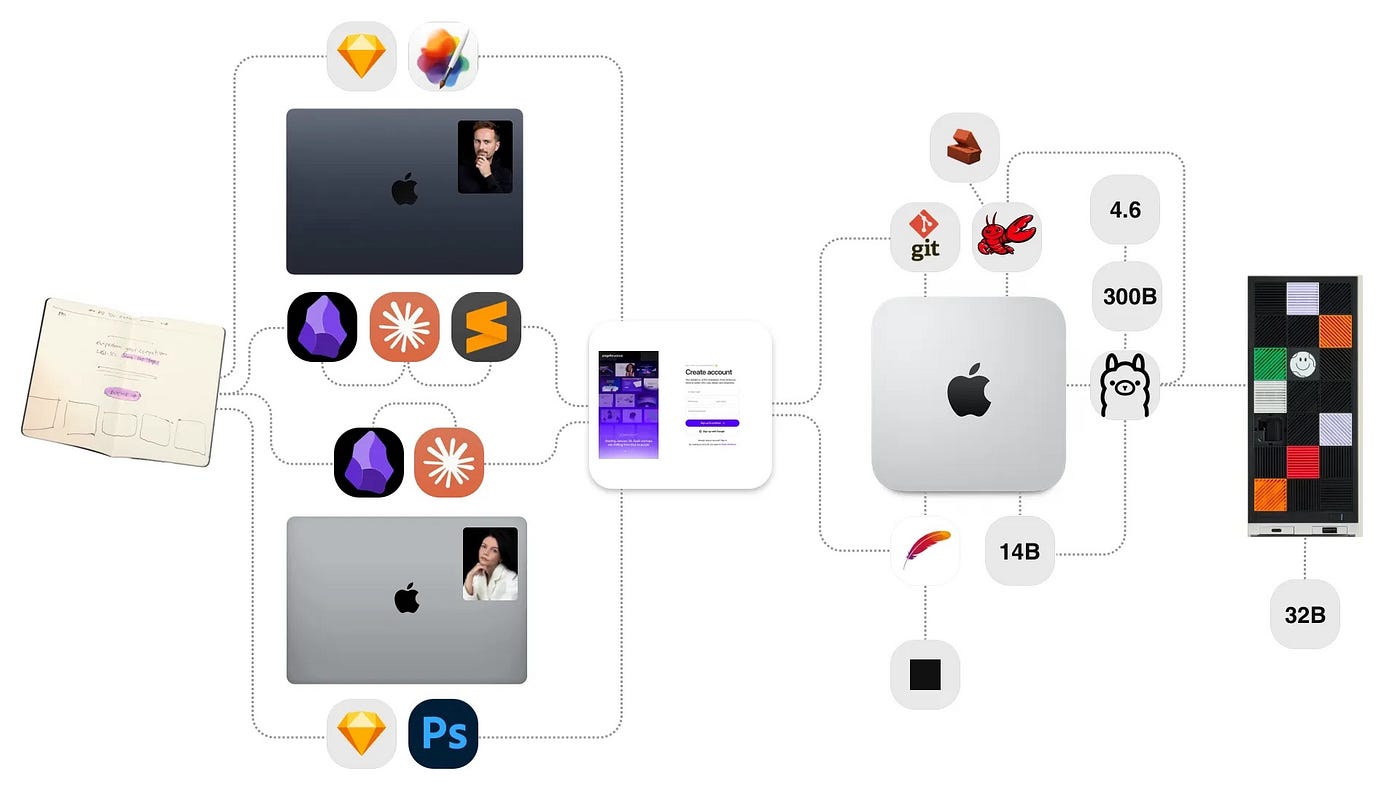
What does it mean for designers and developers? Niching down. Getting away from design systems, dashboards, typical software. Probably moving to local AI's instead of frontier ones. You can take the productivity hit better when you know they're not actively using your knowledge to destroy you.
I know it's tempting to use shortcuts, but these are the same shortcuts that end up costing you the business. Going the long way may be harder, but safer.
Hook your products up in the real world as much as possible. Use proprietary data. If you need to use AI, use local models only. That way at least you'll put up a fight against the oligopoly.
But the future is much, much less software.
All concentrated. Per token billed.
And even the big boys like Adobe aren't safe.
What's Your Reaction?
 Like
1
 Dislike
0
 Love
1
 Funny
0
 Wow
1
 Sad
0
 Angry
0



Comments (0)